Skip to content

Where to Buy Custom Embroidered Name Tags in China?

Finding where to buy Custom Embroidered Name Tags in China takes more than comparing prices. A polished product photo cannot show whether small lettering stays readable, edges resist fraying, or the backing suits a uniform. Those details matter when tags will be worn through busy shifts and repeated washing.

Chinese suppliers range from specialized embroidery factories to broader promotional-product companies. Buyers can assess them through clear product specifications, recent work samples, and direct answers about thread colors, tag dimensions, backing options, minimum order quantities, and production time. Ask for a physical sample when practical. Check the lettering at its actual size, not only on a magnified screen. A neat stitch pattern tells you something. It does not tell you everything.

Communication is part of the product. Share the artwork, fabric choice, expected quantity, and delivery destination before requesting a firm quote. Confirm what the price includes, how revisions are handled, and whether the supplier can provide inspection photos before dispatch. A low quote may leave important details unclear. And that can become expensive. Even a careful checklist has limits; colors may look different under office lighting, and samples may not reveal every production variation. The sections ahead explain how to compare sourcing channels and evaluate suppliers with practical questions, so you can make a better-informed decision rather than choosing on price alone.
Where to Buy Custom Embroidered Name Tags in China?

What Custom Embroidered Name Tags Are and How They Are Made

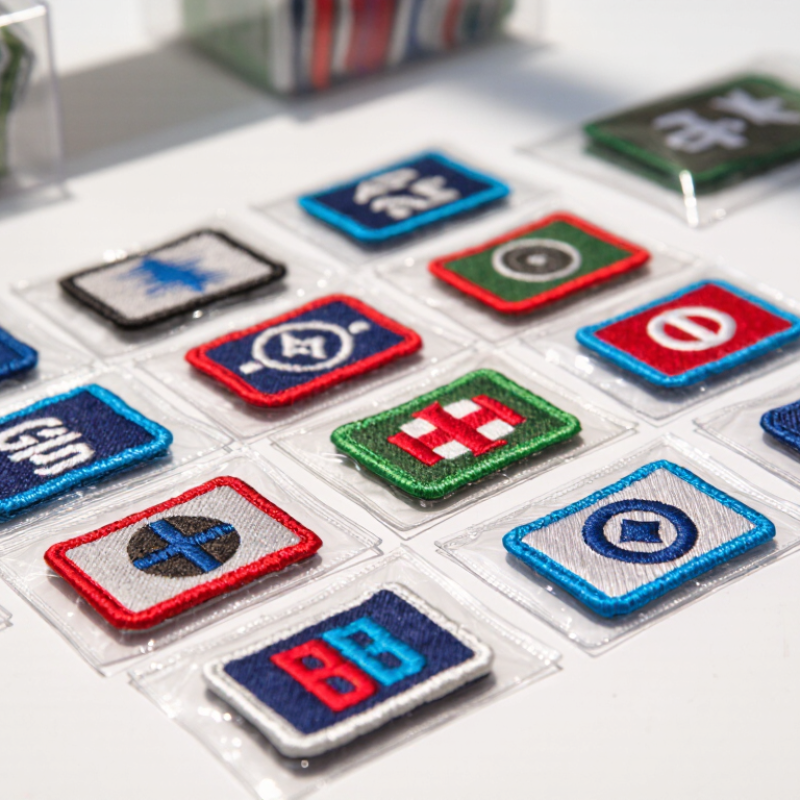
Custom embroidered name tags are fabric labels with names, job titles, or short identifiers stitched into their surface. Unlike printed designs, embroidery uses thread to create raised letters that can be seen and felt. The base fabric, thread color, lettering style, and tag size all affect the final look. Small details matter. A narrow font may become hard to read when stitched at a small size, so clear lettering usually works better than elaborate decoration.

Making a tag begins with artwork preparation. A digitizer converts the design into stitch instructions, setting the needle path, stitch density, and thread changes. The design is then sewn onto a sample fabric, often with a backing that helps the tag hold its shape. After approval, machines embroider the batch, and workers trim loose threads and finish the edges.

Quality checks should look for readable names, even stitching, and secure borders. Even a neat sample can hide problems that appear across a larger run. Ask for a sample and confirm the fabric, dimensions, attachment method, and spelling before production; small adjustments can take time.

Where to Find Name Tag Suppliers in China

China offers several routes for finding custom embroidered name tag suppliers. Search apparel-accessory manufacturers and embroidery workshops in Guangzhou, Dongguan, and Yiwu, then compare them with suppliers listed on established B2B directories or trade-fair exhibitor catalogs. China Customs figures, summarized by the China National Textile and Apparel Council, put the country’s 2023 textile and apparel exports at about US$293.6 billion. The scale is useful, but it does not prove that a factory makes durable name tags. Ask whether the supplier embroiders in-house or outsources production.

Request a sample with your actual artwork, fabric, backing, and thread colors. Check the lettering under bright light. Tug the edges, inspect the reverse stitching, and wash the sample if the tag will be laundered. Small details matter. Ask for the minimum order quantity, sample charge, lead time, and whether the quoted price includes backing and packaging. China’s National Bureau of Statistics reported 1.3% growth in value added for apparel, footwear, and headwear manufacturing in 2023; this offers sector context, not a guarantee about any individual supplier. A neat sample can still hide uneven bulk production. I would request a pre-shipment photo or inspection, even when the first sample looks convincing.

How to Compare Manufacturers and Online Marketplaces

When sourcing custom embroidered name tags in China, compare sampling, stitch control, and reorder consistency—not just unit price. Ask each supplier for a sample made from your actual artwork, fabric, and backing. Check whether small text stays legible, borders lie flat, and thread colors match your specification. Small details matter. A low quotation may exclude setup fees, packaging, or shipping, so request a line-by-line cost breakdown. Online marketplaces make it easier to compare listings and response times, but a polished profile does not prove the seller owns a factory.

Direct manufacturers may offer clearer production communication and more control over repeat orders, while marketplaces provide a broader pool of candidates. Verify who handles embroidery, finishing, and inspection. Request production photos, a written sample approval, minimum order quantity, lead time, and a defect-resolution process.

The World Bank’s 2023 Logistics Performance Index ranked China 19th among 139 economies. That country-level result offers logistics context, not a delivery guarantee for any individual supplier. I would still confirm the shipping method and dispatch date in writing. Before placing a bulk order, compare the approved sample with a finished production piece; I have found that this check is easy to overlook.

What to Check Before Choosing a Supplier

Where to Buy Custom Embroidered Name Tags in China?
What to Check Before Choosing a Supplier

When comparing Chinese suppliers, request a sewn sample before approving a bulk order. Check the lettering at actual size: fine strokes can fill in, while loose threads may catch on clothing. Ask about embroidery density, edge finishing, backing options, minimum order quantity, and remake terms. Small details matter. Confirm the sample uses the same fabric and thread planned for production, not just similar materials.

Ask for written specifications and a clear inspection process. A 2024 Textile Exchange report estimates global fiber production reached 124 million tonnes in 2023, highlighting why material traceability deserves attention. Request fiber composition details and supporting documentation if recycled or organic content is claimed. Also ask how the supplier checks color consistency, spelling, dimensions, and attachment strength. A wash test on the sample can reveal fading or fraying before a larger order is placed.

Lead times need careful checking. Request a production schedule that separates sampling, manufacturing, and shipping, and confirm how delays are handled. Grand View Research estimated the global embroidery market at about USD 1.7 billion in 2022, with continued growth projected. A busy market does not guarantee careful work. Compare suppliers using the same artwork, quantity, and delivery terms, then review their answers—not only their quoted price. One weak point: samples cannot fully predict every production batch. Keep approved samples and specifications for comparison.

Where to Buy Custom Embroidered Name Tags in China? — What to Check Before Choosing a Supplier

Buying Route Best Suited For What to Verify Questions to Ask Before Ordering
Online B2B sourcing platforms Comparing multiple suppliers, requesting quotations, and arranging an initial sample order. Whether the seller manufactures embroidered patches or resells them; business details; product-specific experience; sample availability; and written order terms. Can you share close-up photos of comparable name tags and provide a physical sample? What are the minimum order quantity, sample charge, and production lead time?
Direct embroidery or garment-accessory factories Repeat orders, custom specifications, and buyers who need direct communication with the production team. Equipment and process capability, quality-control steps, capacity for the required quantity, and whether finishing or attachment options are produced in-house or subcontracted. Which production steps are performed at your facility? How do you inspect lettering, edge finishing, backing, and attachment before packing?
Trade fairs and sourcing events in China Buyers who want to inspect physical samples and meet potential suppliers in person. Whether the exhibitor makes embroidered name tags, can follow up with a written quotation, and can provide a sample matching the intended design and materials. Can you quote the same specification at different quantities? Can you provide a pre-production sample and confirm the order details in writing?
China-based sourcing or inspection service Buyers who need help communicating with suppliers, checking samples, or arranging inspections. Service scope, inspection checklist, fees, reporting format, and whether the service provider is independent of the supplier. What will be inspected, when will the inspection take place, and will the report include dated photos and measurements?
Artwork and embroidery setup All custom orders, especially small lettering, detailed logos, and repeat production. Final size, lettering legibility, thread colors, stitch coverage, and approval of the digitized embroidery layout. Embroidery machine-file formats vary, so confirm the supplier’s accepted format rather than assuming compatibility. Will you provide a digital layout or physical pre-production sample for approval? Are embroidery digitizing or setup charges included in the quotation?
Fabric, backing, and attachment Uniforms, workwear, bags, and other uses where durability and attachment method matter. Fabric type, backing material, border finish, and attachment option, such as sew-on, hook-and-loop, or iron-on. Confirm suitability for the intended garment and care instructions. What materials and backing are included? Is the attachment method suitable for the garment fabric and its expected washing or use conditions?
Quotation and minimum order quantity Budget planning and comparison of competing offers. Whether the quote specifies tag dimensions, quantity, materials, attachment, packaging, sample and setup charges, shipping terms, and quote validity. Minimum quantities and prices vary by supplier and specification. Could you itemize the costs and state any quantity breaks, extra charges, payment terms, and shipping arrangement?
Sample approval and quality checks Orders where color, size, text accuracy, or finish must match a particular standard. Approval of a physical sample or clear production proof; agreed tolerances; inspection of spelling, dimensions, loose threads, edge finish, and attachment before shipment. Will bulk production follow the approved sample? What happens if delivered goods do not match the confirmed specification?
Production schedule and shipping Orders with a fixed delivery date or international shipment. Written production and dispatch estimates, destination, shipping method, packaging, and responsibility for freight and import charges. Delivery times depend on the order and route. When does the production clock start? Can you provide the export and shipping documents required for my destination?

Practical tip: Send every shortlisted supplier the same written specification and compare quotations against the same approved sample, dimensions, materials, and delivery terms.

How to Order, Approve Samples, and Arrange Shipping

Where to Buy Custom Embroidered Name Tags in China?

Ordering custom embroidered name tags from a Chinese manufacturer works best when the specifications are clear. Send a tech pack with the finished size, fabric, backing, border style, attachment method, thread colors, and order quantity. A simple reference photo helps, but it cannot replace measurements. Ask for a written quotation covering sample fees, production time, packaging, and shipping terms. Small details matter.

Before bulk production, request a physical sample and check it against the approved artwork. Examine lettering at arm’s length, then inspect the back, edges, and attachment. Test the tag on the intended garment; a backing that feels fine on a desk may be uncomfortable when worn. Confirm color under natural light, and approve any changes in writing. Samples can still differ slightly from a large run, so ask how the factory checks consistency.

Plan shipping before approving production. Confirm the destination, carton dimensions, tracking, insurance, and who handles import charges.

The 2024 DHL eCommerce Trends Report found that 81% of surveyed shoppers may abandon a purchase when their preferred delivery option is unavailable. That finding concerns consumer delivery, not factory freight, but it shows why delivery expectations deserve attention.

Build in time for sample revisions and customs processing. Delays happen. A rushed approval can cost more than a few extra days.