Choosing the best inflatable air dancer starts with the job it needs to do. A figure outside a car dealership must catch attention from passing traffic, while one inside an event hall should fit the space without blocking guests. Measure the display area, check viewing distance, and consider how much visual movement suits the setting. Bigger is not always better. A tall dancer can disappear behind a roofline or feel overwhelming beside a small storefront.
Look closely at fabric, seams, blower requirements, and printed details before ordering. Ask the supplier for the product dimensions, recommended operating conditions, and care instructions; specifications can vary between models. Check that the blower and power source match the setup, and keep the unit clear of obstacles. Airflow matters. If the dancer will be used outdoors, consider wind exposure and follow the manufacturer’s guidance for anchoring and operation. A bright color may draw eyes, but readable lettering and a clear design often matter more from across a parking lot. Small details matter.
There is no single best choice for every business. Compare product information, review customer photos when available, and confirm what is included in the price. I would also pause before choosing a design based only on its online appearance; screen colors and real-world visibility can differ. A well-matched inflatable air dancer should suit the location, audience, and practical setup—not just look impressive in a product image.
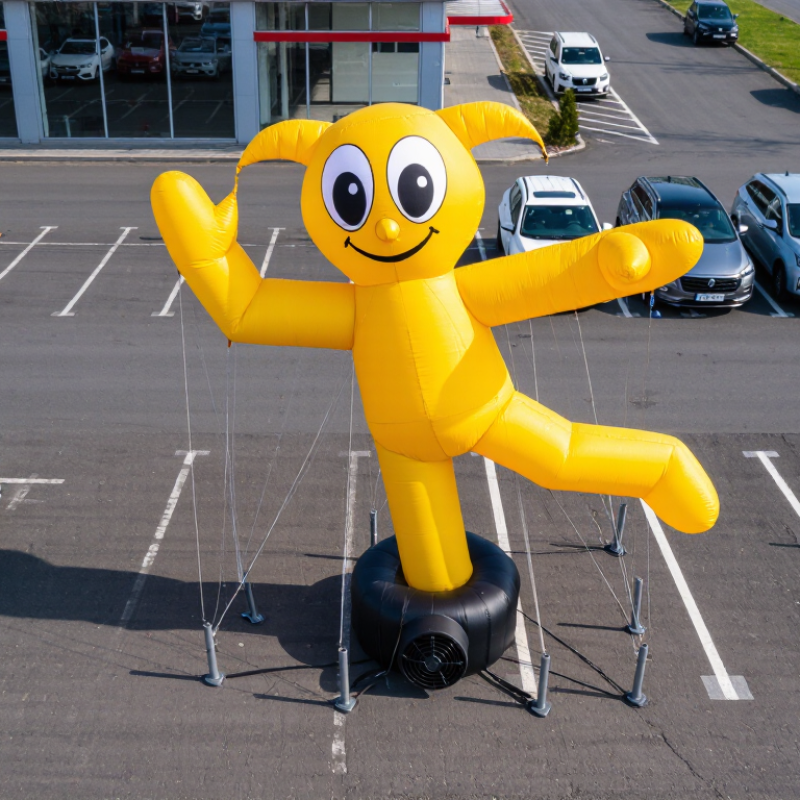
Before choosing height, color, or movement, decide what the inflatable air dancer needs to do. Is it guiding drivers toward a roadside sale, drawing families to a community fair, or helping visitors find a trade-show entrance? Each setting calls for a different design. A tall, high-contrast figure may stand out across a parking lot, while a smaller, calmer display can suit a crowded indoor aisle. Picture the actual viewer: someone passing in a car has seconds to notice it; a parent with children may need a clear direction and safe walking space. That distinction matters.
EventTrack 2019, an experiential-marketing benchmark by Event Marketer and Mosaic, reported that 91% of surveyed consumers felt more positively toward brands after an experience, and 85% were more likely to buy. These figures concern brand experiences broadly, not air dancers specifically, so treat them as context rather than a promise. Match the display to the audience’s likely age, viewing distance, and reason for visiting. Check ceiling height, power access, noise tolerance, and outdoor exposure before ordering. A waving figure can attract attention, but it can also distract or feel out of place. I would reconsider the choice if its message is unclear from the main approach.
| Purpose | Primary Audience | Suitable Setting | Features to Consider | Practical Checks |
|---|---|---|---|---|
| Attract attention to a roadside business | Drivers and passersby | Open frontage with clear visibility from the road | A tall, high-contrast design; simple lettering that can be read quickly; movement visible from a distance | Check local signage rules, sightlines, power access, and secure anchoring. Keep the display clear of traffic and pedestrian routes. |
| Promote a store opening or sale | Local shoppers and nearby foot traffic | Store entrance, forecourt, or event area | A clear promotional message, colors that contrast with the surroundings, and a size appropriate to the available space | Confirm that the fan has a suitable power source and that cords, stakes, and guy lines will not create trip hazards. |
| Create a lively atmosphere at a community event | Families, event visitors, and participants | Outdoor fair, festival, sports event, or open gathering space | A friendly character or bright colors; stable placement; a design that is easy to recognize in a busy setting | Follow the product instructions for operation and anchoring. Monitor wind conditions and use only where the display can be safely supervised. |
| Guide visitors to a venue or entrance | First-time visitors and event attendees | Approach to a venue, entrance, or permitted wayfinding point | A straightforward directional message, readable colors, and placement that is visible without blocking signs | Ensure the display does not obstruct accessibility routes, emergency exits, official signs, or drivers’ views. |
| Support a short-term campaign or seasonal promotion | A specific local customer group or event audience | Temporary outdoor display area or event site | A design matched to the campaign; replaceable or reusable graphics where available; convenient transport and storage | Check setup time, packed size, cleaning and drying instructions, and whether the unit is intended for the expected weather conditions. |
| Selection tip: Define the audience and viewing distance first, then compare size, message readability, power requirements, placement, weather guidance, and anchoring instructions. Actual suitability depends on the product specifications and site conditions. | ||||
Choose the height of an inflatable air dancer according to viewing distance and nearby obstacles. A small figure can disappear beside a wide storefront, while an oversized one may block windows or compete with signs. Measure the clear space, check overhead clearance, and consider whether people will see it from the road or sidewalk.
Visibility matters: OAAA’s 2023 consumer research reported that 76% of surveyed adults noticed an out-of-home advertisement in the previous month. That finding concerns outdoor advertising broadly, not air dancers specifically, but it highlights the value of a clear sightline.
Match the shape to the message and setting. A simple waving tube reads clearly from a distance; a character-shaped design can feel more distinctive close to an entrance. Check that its fabric, blower, and base suit the intended indoor or outdoor use. Keep the display away from vehicle paths, doors, and overhead wires, and follow the manufacturer’s setup and anchoring guidance. A taller design is not automatically more effective. I would reconsider any placement that looks impressive in a photo but feels cramped on site.
Tips: View the spot from the customer’s approach, then from the side. Keep the base level, secure the display as directed, and test it before opening. Leave enough space for airflow. Check again after setup; small adjustments can make a noticeable difference.
Choose fabric by construction, not denier alone. A tightly woven polyester shell with a suitable coating can resist light rain, but seams and blower openings remain vulnerable. Check fabric weight, seam reinforcement, and any water-resistance test results. ASTM D751 provides test methods for coated fabrics; ask for the actual report, not just “weatherproof” on a product sheet. Small details matter.
Sunlight can quietly weaken both fabric and color. The World Health Organization reports that up to 80% of UV radiation can pass through light cloud cover, and fresh snow can reflect up to 80%. So a cloudy day is not a reliable fade test. For print quality, request AATCC TM16.3 lightfastness results, including exposure hours and color-change ratings. Compare like-for-like tests. A vivid sample may still fade quickly outdoors.
Inspect print edges and fine lettering at a few metres, then check them close up for banding or blurred seams. Sublimation can produce sharp color on compatible polyester, but the fabric and ink process both affect results. I used to treat bright color as proof of durability; that was too simple. Ask for an outdoor-exposed sample, and check the printed area after folding and inflation. A little extra scrutiny helps.
Compare fabric durability, outdoor weather resistance, and print friendliness before choosing an air dancer.
Scores are indicative 1–5 ratings based on typical material trade-offs, not standardized test results. Actual performance depends on fabric weight, coating, construction, printing method, and exposure conditions. Inflatable displays should be secured and brought indoors during severe weather.
Before buying an inflatable air dancer, match the blower’s airflow rating to the figure’s height and fabric size. Check both cubic feet per minute and static pressure; wattage alone does not show how well a blower keeps fabric upright in wind. The U.S. Department of Energy’s industrial motor-systems assessment estimates that motors account for about 69% of manufacturing electricity use. That figure is not specific to display blowers, but it underlines why correct sizing matters: an oversized unit can waste power, while an undersized one may leave the dancer limp.
Read the nameplate for voltage, amperage, and plug type, then compare these with the available outlet and circuit capacity. Include other devices on that circuit. For outdoor setups, choose weather-rated connections and keep plugs off wet ground; use a properly rated extension cord, not a thin household lead. Keep it dry. A small voltage drop over a long cord can make startup unreliable.
Measure the site before ordering. Allow space for the blower intake, fabric movement, and secure tie-down points, and keep the intake clear of leaves or loose packaging. Check whether the unit needs continuous operation and whether its noise suits the location. A tidy setup can still fail if its cord crosses a walkway or the blower sits where rain collects. Recheck the manufacturer’s electrical and anchoring instructions on arrival; specifications can be easy to misread.
A reliable air dancer starts with a stable base, secure tie-down points, and a blower protected from rain. Check the power cord for damaged insulation, and keep plugs off wet ground. The National Fire Protection Association’s report Electrical Fires (2022) estimates that electrical distribution and lighting equipment contributed to an average of 34,000 U.S. home fires annually. That figure is not specific to air dancers, but it underlines why electrical checks matter. Choose a unit with clear setup instructions and a warranty that states coverage periods, exclusions, and who pays return shipping. A long warranty is less useful if blower failures are excluded.
Maintenance is simple, but easy to skip. After each use, let the fabric dry fully before folding it; trapped moisture can cause mildew and weaken seams. Inspect stitching, fan housing, and anchor points for fraying or cracks. Clean the intake screen so dust does not restrict airflow. A neat setup can still hide a worn cord, so check it by hand and sight before plugging in.
Tips: Use only the power supply specified by the manufacturer. Secure every anchor, especially on grass or uneven pavement, and take the unit down when wind or rain exceeds its stated limits. Keep a brief log of cleaning, repairs, and warranty dates. It feels fussy, but it can reveal recurring problems early.