Interest in women’s golf clubs is growing, but a label alone cannot tell you whether a set will suit your swing. The National Golf Foundation’s 2024 participation reporting counted about 7.9 million women and girls playing on-course golf in the United States in 2023. That figure signals a substantial audience; it does not measure demand for clubs made in China. A useful comparison must look beyond country of manufacture.
Club designer Tom Wishon is widely associated with this fitting principle: “There is no such thing as a standard golf swing, so why should there be a standard golf club?” It is a practical reminder. Shaft weight, flex, club length, grip size, and loft can change how a club feels and performs. For Chinese-made women’s sets, shoppers should check those specifications, the materials, independent reviews, warranty terms, and access to fitting—not just the price or “ladies” label.
Fit matters. In the sections ahead, we’ll compare complete sets and individual clubs, and explain what to inspect before buying. Product claims can be difficult to verify, and published participation data cannot establish build quality. That limitation matters. A low-cost set may be a sensible starting point, but only if its specifications suit the golfer and replacement support is clear. The best choice is not automatically the lightest, newest, or cheapest; it is the set that performs reliably for the player holding it.
Defining the best women’s golf clubs made in China starts with performance, not a country label.
Manufacturing location alone does not prove quality. Look for clear specifications, consistent assembly, and testing that matches recognized equipment standards. A reliable seller should explain shaft flex, club length, grip size, and head design without vague promises.
Fit matters. A player with a slower swing may benefit from a lighter shaft, but lighter is not automatically better.
During a fitting, compare several clubs and note launch height, carry distance, and how the club feels through impact. Check whether the grip sits comfortably in the fingers and whether the clubhead feels stable on off-center strikes. Small details count.
I would not choose a set from catalog numbers alone. Ask how quality is checked across production batches, and whether materials and specifications are documented. Independent reviews can help, though they may not reflect your swing.
Try the clubs on a range if possible, using the same balls and targets for each test.
Feel matters.
A little uncertainty is normal; the right choice depends on fit, repeatable results, and honest product information.
Chinese women’s golf-club sets come from domestic consumer brands and OEM makers that produce equipment for other labels. OEM suppliers may offer drivers, fairway woods, hybrids, irons, wedges, and putters in coordinated sets. Their catalogs can look similar, but specifications and quality control vary.
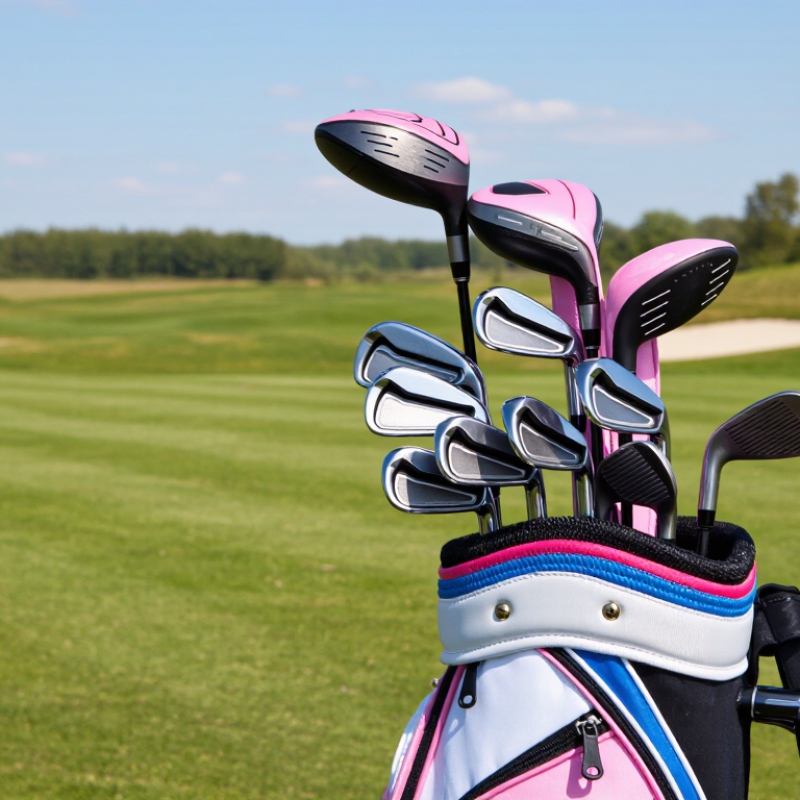
For a women’s set, check more than the pink finish or lightweight claim. Compare club length, shaft weight and flex, grip size, and total set composition. A shorter player may struggle with standard-length clubs; an overly light shaft may also feel unstable. Small details matter. Ask for written specifications and confirm whether the listed shaft and grip are standard or optional. Fit varies.
When evaluating an OEM maker, request sample clubs and inspect the finish, head alignment, grip attachment, and consistency across the set. Ask how the maker checks loft and lie angles, and whether replacement components are available. A factory’s ability to produce clubs for a label does not prove that every set suits every golfer. Retail brands may provide clearer fitting support, while direct OEM sourcing can allow customization but may offer less help after purchase. I would treat unusually broad performance promises cautiously, especially without test data or a clear return policy.
Loft progression is a practical specification for comparing women's golf club sets made by Chinese brands and OEM manufacturers. The values shown represent common retail specifications: higher-lofted clubs are generally easier to launch, while lower-lofted clubs are designed for longer distance. Shaft flexibility, club length, head size, and set composition should also be checked before purchase.
What Are the Best Women's Golf Clubs from China?
How Loft, Shaft Flex, Length, and Clubhead Design Affect Fit
Choosing women’s golf clubs from China should begin with fit, not appearance or price. Loft controls launch, carry, and stopping power. A higher-lofted fairway wood can help a slower swing send the ball higher. Too much loft, however, may reduce distance for stronger players. Test clubs with the same ball and launch monitor when possible.
Shaft flex affects timing and contact. Many recreational golfers need a lighter, more flexible shaft, but swing speed alone is not enough. Tempo, release point, and physical strength also matter. During fitting, compare two flex options and watch dispersion, not only the longest shot. I have seen golfers choose softer shafts because they feel comfortable, then lose control in windy conditions.
Length changes posture and strike quality. A club that is too long may create thin shots and heel contact. A shorter club can improve balance, although it may reduce clubhead speed slightly. Clubhead design matters too. Wider soles help golfers move through soft turf, while perimeter weighting can protect mishits. Check measured specifications carefully, because stated loft and length may vary between production batches. I would not trust a fitting based on one swing. Recheck it outdoors, where wind exposes weaknesses.
| Club Type | Typical Loft Range | Common Women's Length Range | Shaft Flex Considerations | Clubhead Design and Fit Notes |
|---|---|---|---|---|
| Driver | Typically 11°–13° | Approximately 43–44 inches | A lightweight ladies-flex shaft may suit players with slower or moderate swing speeds. Flex labels are not standardized, so compare feel and measured performance. | A larger, high-moment-of-inertia head can help maintain ball speed on off-center strikes. Adjustable loft can help tune launch and trajectory. |
| Fairway Wood | 3-wood: about 15°–17°; 5-wood: about 18°–20°; 7-wood: about 21°–24° | Approximately 41–42.5 inches for a 3-wood; shorter for higher-numbered woods | Choose a shaft weight and flex that allow a balanced swing and consistent contact; a slightly shorter club may improve control. | A shallow face and low center of gravity can make it easier to launch the ball from the fairway. Higher-lofted woods can be useful alternatives to long irons. |
| Hybrid | Commonly 19°–28°, depending on the club's intended iron replacement | Approximately 38.5–40 inches | Flex should support a smooth tempo without feeling difficult to load. Compare the hybrid's shaft with the longest iron or fairway wood in the set. | A compact, rounded head can help with play from the fairway, rough, and some uneven lies. Match its loft to the adjacent clubs to avoid distance gaps. |
| Irons | Modern 7-irons commonly range from about 28°–34°; lofts vary substantially by set design | Approximately 36–37 inches for a 7-iron; individual club lengths vary through the set | Lightweight graphite or lighter steel shafts are options, but material alone does not determine fit. Test flex, weight, tempo, and strike consistency together. | A wider sole, perimeter weighting, and a lower center of gravity can assist launch and forgiveness. The right design depends on strike pattern and preferred trajectory. |
| Wedges | Pitching wedge: often 42°–46°; gap wedge: 48°–52°; sand wedge: 54°–56°; lob wedge: 58°–60° | Approximately 33.5–35 inches, depending on wedge type and set design | Many players prefer a controlled, repeatable feel for partial shots. Check that wedge shafts blend comfortably with the iron-set shafts. | Sole width and bounce affect turf and sand interaction. More bounce can help in soft conditions or with a steep delivery; less bounce may suit firmer conditions or a shallow delivery. |
| Putter | Usually no loft range is used for fitting in the same way as irons; putter face loft is commonly around 2°–4° | Often 32–35 inches; choose by posture, arm hang, and eye position rather than height alone | Shaft flex is generally not the main putter-fit variable. Prioritize length, balance, grip size, and a comfortable stroke. | Blade and mallet shapes offer different alignment and balance characteristics. Select a head that helps aim consistently and produces a predictable roll. |
| Fit note: These are common approximate ranges, not fixed specifications. Women's clubs are not defined by one universal standard, and products made in China can vary by model and intended player. A fitting should account for height, wrist-to-floor measurement, swing speed, tempo, strike location, launch, and distance gaps. | ||||
For women choosing golf clubs made in China, rule compliance matters as much as weight or feel. Under Rule 4.1b(1) of the USGA and R&A Rules of Golf, a player may carry no more than 14 clubs during a round. The USGA/R&A Equipment Rules also set a 48-inch maximum length for clubs other than putters. These limits apply regardless of a club’s country of manufacture or intended player.
That 48-inch figure is a ceiling, not a recommended driver length. A longer club can be harder to control, especially when a player’s stance or swing speed is still developing. Check the club’s measured playing length, not just a catalogue description; measurement follows the Equipment Rules’ specified method.
A set with fewer than 14 clubs is permitted, too. There is no need to fill every slot.
Small details matter: a club that feels comfortable at the range may behave differently on uneven turf.
Tips: Before buying, count the clubs in your bag and verify each non-putter’s length with the seller. Ask for specifications in writing. The USGA and R&A Equipment Rules are the authoritative references for these limits; still, product listings can be incomplete. I would not assume a “women’s” label guarantees a suitable fit. Test the grip, reach, and swing weight if possible.
What Are the Best Women's Golf Clubs from China?
Performance should be tested, not assumed. NGF’s 2024 participation reporting places women at roughly one quarter of U.S. on-course golfers. That demand supports more women’s equipment choices, including clubs manufactured in China. Ask for launch-monitor results using your own swing speed. Check carry distance, launch angle, spin, and dispersion. A lighter shaft is not automatically better. My own testing experience suggests consistency matters more than one impressive shot. That is easy to forget.
Conformity protects competitive use. The USGA and R&A equipment standards limit driver head volume to 460 cubic centimeters and regulate club performance. Search the official conforming-club database before paying. Ask the seller for the exact model code, loft, shaft length, and face construction. Do not rely on phrases such as “tour level.” They prove little. Independent measurements are stronger evidence. Still, some online specifications remain incomplete.
Warranty terms deserve equal attention. A clear policy should state coverage length, return shipping, manufacturing defects, and replacement procedures. Request written confirmation before ordering. Check whether the warranty is handled locally or requires international shipping. That detail can change the real price. Compare the club’s total cost with fitting, duties, and possible repairs. The R&A and USGA Distance Insights Report shows that distance gains involve both equipment and player factors. Therefore, value should include fit and control, not distance alone. I would also keep a record of every measurement. Small errors happen.